
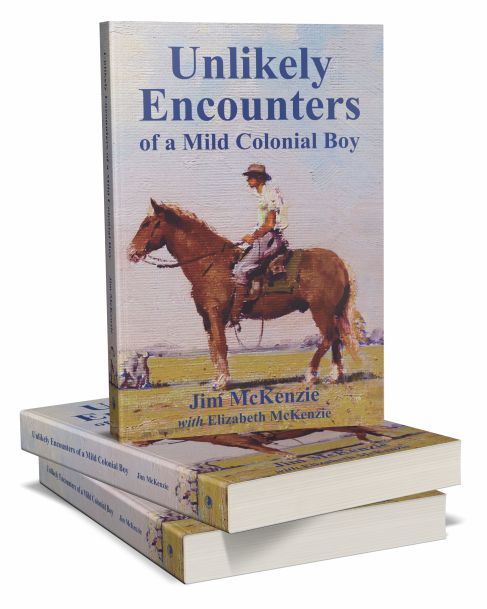
Unlikely
Encounters

of a Mild Colonial Boy

ABOUT THE BOOK

Stories spanning over a century from the life of TJ ‘Jim’ McKenzie, his family, friends and people along the way, from the 1890s to 2020s. Recollections growing up near Longreach CQ from the mid-1930s, early boarding school to National Service, life on sheep stations to meeting Princesses. From sheep shearing to pen pushing. From rural living and working to city life and raising a family from the mid-60s. Jim experienced early tragedy and unusual opportunities, and some unlikely encounters.

This collection of anecdotes provides an account of some of the encounters and perspectives, some universal and others unusual, of a mild country boy living in a time of personal and cultural changes and happenings. Delivered with a dash of humour and a somewhat philosophical perspective, it offers a potential chuckle, as well as historical insights into ways of living and working which at times seem to have faded from our modern and urban view, along with some of the characters.

ABOUT THE AUTHOR

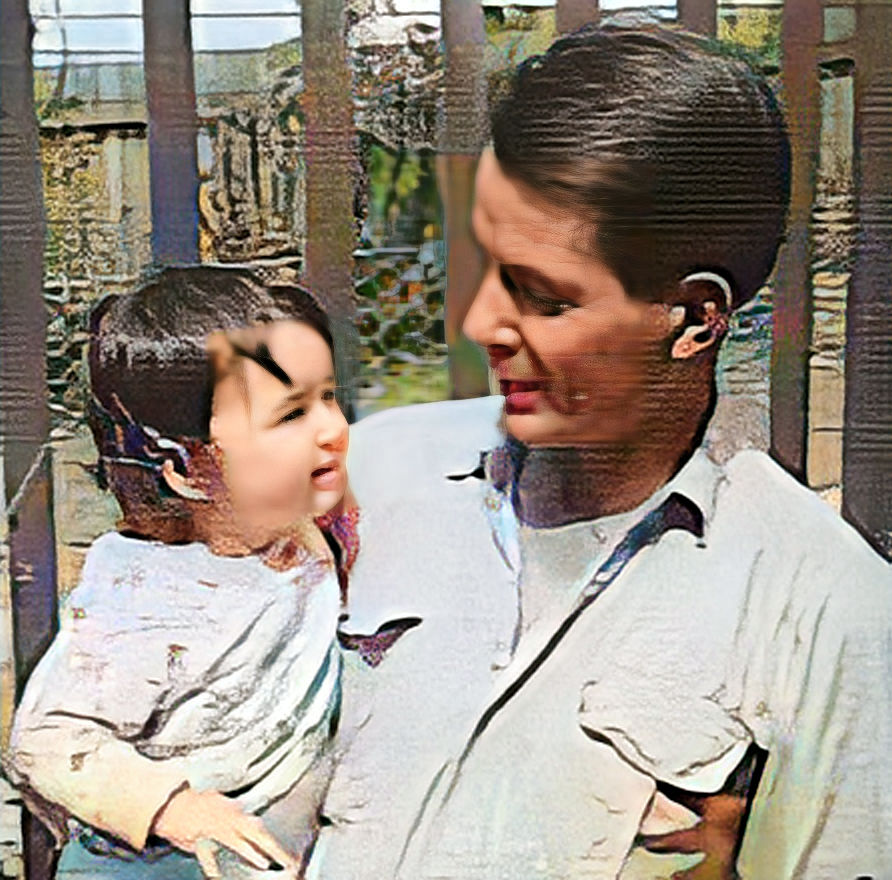
Elizabeth & Jim

Born Thomas James McKenzie in Muttaburra CQ in 1935, into pioneering grazier families. Known as ‘Jim’, he experienced early family tragedies and boarding schools while growing up; followed by property work, and a stint in National Service (Nashos) like many young men of the era. As a result of distinguished visitors to Longreach and the family home of ‘Rosebank’, he experienced some unusual meetings and opportunities during the 1950s and ‘60s.

Despite hopes of ‘life on the land’, Jim commenced a new unchartered life in Brisbane from mid-1965, ending up in the administrative workings of the financial sector from the 1970s to late ‘90s.

Retired since 1997, Jim led a fairly quiet life with wife, Pat, in Brisbane, with interspersed travel visiting family, friends and old haunts. Married to Patricia for nearly 57 years, with three children, Elizabeth, James, and Alexander born in Brisbane in 1967, ‘68 and ‘69, respectively, and three grandsons, Jack, Oscar and Finn. Patricia, who has Alzheimer’s, now lives in aged care, while Jim lived at home with health challenges, including macular degeneration, until his passing in September 2022.

Daughter Elizabeth returned to Brisbane in December 2013, to study and care for her parents after living in Sydney for 20 years, and eventually became co-author of this tome.
THE CHAMELEON - 1949
Probably in the 2nd term of ‘49, someone came up with the idea that we needed a Form Captain. It might have been the Master and seemed harmless enough at the time. We innocents voted for someone we thought was a pussycat, but he took the position seriously and turned into a tiger.

For some of us our faith in docile Class Captains had been shattered, so a certain group were determined to elect a real pussycat, which would entail multiple voting.

There were only two candidates, and the procedure involved writing their names on a slip of paper and the result posted on the blackboard. The election went off without a hitch and our man was elected Class Captain. From where I sat there was one glaring anomaly: our candidate got as many votes as there were in the class, and the former Captain, got half as many again. The Master didn’t notice this from where he was and declared in favour of our candidate.

The former Captain was only too happy to point out this discrepancy to the Master, who was amazed, incensed, and demanded to know who had voted more than once. About eight hands went up and I admitted to voting twice, which I had done. One of my co-conspirators admitted to four votes – he must have been desperate for change!

After school, the Master had about eight of us who had cast additional votes assemble at Forrest House. In the spare room where Flea used to give me a haircut on the rare occasion I could afford it, we were given the cane according to our extra votes. There was nothing new about the cane, which I was familiar with at St Ursula’s in Longreach in ‘43.

After all that, the satisfying thing was there was no re-election and our pussycat got up! Even then, we knew life is not always fair!
‘WHAT CAN I SAY?’ C. 1949-52
I expect some people to be sceptical of what happened here.

At Bullens, about 25 miles from town, a boundary-rider, William (Bill) Hughes Cullen, had finally tired of his solitary state and advertised in a Brisbane newspaper for a bride. At the same time, North Korea was about to invade the South, which would mean Australia would be ‘living off the sheep’s back’, possibly making a worker on a sheep station an attractive proposition. A number of the optimistic respondents must have considered this to be so, as some replied with multiple applications to enhance their chances of matrimonial bliss.

It is unknown what process of elimination was used, but in due course, to widespread surprise, a lady arrived in Longreach after a two-day train trip from Brisbane. Then by taxi, past the homestead, the Findlay’s home at Glen Thompson and onto the boundary-rider’s hut at Bullens. When she set eyes on the prospective groom and what her domestic living arrangements would be, she declined to get out of the vehicle and refused point-blank to enter into a pre-nuptial agreement! It was just a room about 10-12 feet long with a stove at one end and overhead tank above. Alf Cain, the AWU rep must have never ventured down to Bullens, although he caught me twice at the homestead and presented me with accounts for AWU tickets.

Back at ‘Rosedale’, there was the matter of a large taxi fare to be dealt with, so Great Uncle Jack Lubeck offered her a position as cook, in which she remained for some time in a satisfactory, but single condition.

In 1952 Bill was still there, so I worked with him if I was at his end of the run, mustering etc. Although deaf, possibly from WWI, he was good natured and entertaining. Whenever the matter of the 127 marriage applications was raised, which was often, he’d enjoy it as much as anyone. This fairly unique event transpired about two years before Lew and I got there. I think Alf Findlay thought it most amusing, but I found it difficult to envisage. I had no idea so many people wanted to get married.
THE DONKEY - 1953
Hot water at Macarthur House and the school gym at King’s was never a problem - there wasn’t any, but at Wacol, unless we were on bivouac, hot water for showers etc was provided by four or more large metal donkey boilers, except when my squad was on duty, which seemed to be far too often. I prefer not to be in charge of incompetence (if only we’d had a fireman in the squad), but hardly ever failed to be so. I had plenty of privates to choose from, but they and their leader were not familiar with coke burning boilers. As dissatisfaction spread, I took to not loitering at the donkey room and tried to deny any responsibility for hot water. Like many things it should have been easy, but we were no stokers! There was one boiler, and six donkeys trying to fire it up!

In time, I found the best approach to this major inconvenience was to stand in line and complain about it like everyone else. I didn’t like it any better than they did!

Had we been stokers on the Cunard - White Star Liner: ‘Titanic’, it’s unlikely there would have been any causalities in April 1912, as there wouldn’t have been enough steam in the boilers to clear the wharf. This situation was an extreme embarrassment too, because as in all other activities in National Service I got them so nearly right!! The prisoner in the guardhouse didn’t escape anyway. I don’t think I had the keys.
‘ROSEDALE’ - WHAT THE BUTLER SAW
Unintentionally, I seemed to have been busy away from the homestead whenever domestic disturbances occurred, so most altercations were hearsay from the Boss’s father, I’m happy to admit. The manager never bothered to mention them, which was ok with me.

Alf, Monte and I were taking a mob of weaners (young sheep needing a lot of counselling) across Big Elibank, through #4 where we put them on water at Glen Thompson dam. Monte was Alf’s black kelpie, and if you were on horseback he saw you as a co-worker. If you were on foot - lunch! When I passed on foot within 50 feet, his hackles rose, his teeth bared, as he hit the end of his chain. Monte sure wasn’t a whimp.

Paddy was a stationhand about twice my age, seemingly practiced in the art of knife-handling. Perusal of his upper lip indicated at least one of his acquaintances was equally proficient with the instrument. Whatever Paddy was doing this day wasn’t what the Boss had in mind.

I got home to be informed by his father that the manager had intervened when Paddy, seeking affection, thought wielding a knife might press his case, which led to Lew having to stop him chasing the cook round the laundry table with a knife, and terminating his services. Thank God I missed it. Mr Taylor Snr’s relating of the incident was all I needed to know.

At Glen Thompson there was a small garage for the FJ Holden ute, which was also home to Monte, the chain stretcher. I’m pretty confident anyone who tried to steal Alf’s ute would have lost at least part of an arm! Just behind the garage was a Fabrique Nationale (FN), Belgium sedan car. I always assumed it must have belonged to Great Grandfather Spence, but about 20 years ago I learnt it had originally been registered to Rose Ann McKenzie of ‘Rosebank’ in 1916. What it was doing at ‘Rosedale’ I don’t know, but some collector in Melbourne has it now.
THE CENTENARY VISIT – AUGUST 1959
We still hadn’t met any of the royal party, and Dad, Rosemary, Sterling, Judith and I were sleeping at the shearers’ quarters. Dad had brought in four of his grey horses from ‘Rosehearty’, which no one got to ride due to the time constraints.

Breakfast on August 28th was a fairly crowded affair (a dozen or more) which we had in the staff dining room, after which Auntie Heather asked me to call at Boldermans in town for some groceries. Dad said he’d come too. It was a public holiday and it seemed there was plenty of time to waste, so we started wasting it. We went to the club for a beer or two.
George Hickey was at the bar, and Jack Shillington was behind it!
‘Good day Tom; what’s the Princess like Jim?’

‘Don’t know George, haven’t met her yet!’ Then very briefly to the rodeo, after which it seemed it might be an idea to head home for lunch, although we weren’t sure where, as we hadn’t been in our dining room for 24 hours. As we crossed the Gin Creek with a small box of groceries, there was a BIG cloud of dust coming like a bat out of hell. As the car passed over the Council Reserve grid it was probably airborne for a time. I got off the road and stopped in case we had a head-on. I thought someone must have been late for the rodeo, but no, it was Uncle Frank as mad as hell. When Dad and I collected Grandma from ‘Longway’ next morning, I neglected to tell her: that at a given time and place and with her son-in-law at the wheel, her Holden ute could go like the clappers!
No one told me I was responsible for the safe arrival of the tinned salmon for the royal soufflé. Dad said,
‘It wouldn’t matter what you did boy, you’d still be wrong!’

That didn’t seem to help much so I took off like a bat out of hell too, although if Uncle Frank had taken the salmon it would have got home quicker! We hadn’t been advised if we’d be getting any lunch, and if so where it might it come from. Mrs Dawson, former ‘Baratria’ cook, turned out a lovely soufflé, which could have been assisted by the tinned salmon getting a good shakeup on the way home!

We still hadn’t met any of the royal party, but at about 1.30 pm Uncle Frank said we’d be lunching in the dining room, and as we would be in esteemed company a necktie would be needed. As all mine were at the shearers’ quarters, Uncle Frank said,
‘Pick one out of the garage.’

I knew the ties were there, often wondered why, and thought they were all awful. After much procrastination I picked the only one I could wear without acute embarrassment; it had a nice subdued pattern. I was informed later it was a morning-suit tie and everyone at lunch knew that, except me!